Four steps from thinking about it to logging hours. No enrollment fees. No monthly dues. No commitment until you say so.
Whether you've dreamed about flying since you were a kid or you drove past a Cessna last Tuesday and thought "maybe", the path in is the same. A free conversation, a demo flight, and then your first real lesson on the calendar in proven aircraft that have trained generations of pilots. We're honest with you about cost, timeline and what to expect before you commit anything.
A note from the owner
"I personally meet with every new student to answer any questions you have about flying. Whether you are brand new or just exploring your options, I am happy to help you get started. Whether you are pursuing the skies for the sheer joy of flight or aiming for a professional airline career, this is where your journey begins. At Aces High Aviation, we offer comprehensive flight and airline training programs tailored to your goals."
– Sam Raymond, Owner
01 /
The Four Steps
Consultation · demo · enroll · prep
01.
Free Consultation with Sam60–75 minutes · no commitment
Before jumping into flight training, we offer a completely free 60–75 minute sit-down with Sam, the owner of Aces High Aviation.
It is the best way to get familiar with how we operate and make sure all your questions are answered before taking off.
Most students choose to do this meeting before booking a demo flight, though it is completely optional if you would like to do it after. Our goal is to make sure you are fully informed, comfortable, and confident before getting started. We will talk about your goals and build a training plan that fits you.
In the free meeting · eight topics + your questions
M · 01
How Aces High runs.
How the school operates day to day and what makes us different from any other school.
M · 02
Typical lesson structure.
What a typical lesson looks like from preflight through debrief, and how lessons build on each other.
M · 03
Cost & timeline.
Setting realistic expectations for cost, timeline, and progress based on your goals and availability.
M · 04
The road ahead.
What you will encounter as you progress through your flight training: the milestones, the plateaus, and the wins.
M · 05
What you need to do.
What you will need to do on your end to make this successful: self-study, consistency, prep between lessons.
M · 06
Exams, medical, insurance.
Info on written exams, FAA medicals, student pilot certificates, insurance options, and other practical matters.
M · 07
Full facility tour.
A complete tour of the aircraft and training facility: ramp, briefing rooms, simulator, the works.
M · 08
Your questions.
Plenty of time to ask any questions. Nothing is rushed. No question is too small.
02.
Schedule a Demo FlightFrom $230 · counts as your first hour
A demo flight is your first real lesson, not just a ride. You will be in the pilot's seat, flying the aircraft with a certified instructor beside you. It gives you a true feel for what flight training is like: the controls, the headset, the views, the vibe, and how lessons actually go.
Best of all, it is not just for fun. It is logged as your first official hour of flight time, and it counts toward your Private Pilot License. If you are curious about flying but not quite ready to commit, this is the perfect way to experience what it is really like.
Enroll as a StudentWaitlist · study guide · ground school
We keep a waitlist for primary CFI slots. Joining is free and locks in your spot in the order you sign up.
While you wait, you get going on the homework. We send you the Aces High Study Guide PDF the moment you sign up, and we recommend the Pilot Institute online ground school to start working through written-test material. Students who walk in already knowing the basics get through training faster, and cheaper.
When a slot opens, we pair you with the right instructor for your goals and your schedule. No deposits, no membership fees, no enrollment fees, nothing. You pay only for the aircraft and the instruction you actually use.
Start the New Student GuideEverything you need before lesson one
Once you are on the list, dive into the New Student Starter Guide. It walks you through what to expect, what to bring, and how to prepare, so your very first hours are productive rather than spent catching up.
Everyone starts in the same place: walking in the door. Here is the path, and the hours, from your very first lesson to the right seat of an airliner.
Start0 hrsWalk in the door.
+ ~70 hrsPPL~70 hrs totalPrivate Pilot License.
+ ~55 hrsIFR~125 hrs totalInstrument Rating.
+ ~125 hrsCommercial250 hrs totalGet paid to fly.
+ CFI ratingCFI~260 hrs totalTeach & build hours.
+ ~1,240 hrsAirlines1,500 hrs totalAirlines.
CFI is the most common road, not the only one. The moment you earn your Commercial certificate at 250 hours you can get paid to fly straight away. Plenty of our students have gone on to traffic watch and aerial photography, banner towing over the beach, pipeline patrol and survey work, or flying jumpers for skydiving operations. Instructing is a choice, not a requirement.
03 /
Age, Medical & Paperwork
FAA requirements · age limits
A · 01
No upper limit.
Our students have ranged in age from 10 to 82+. There are no age limits to take lessons with an instructor.
A · 02
16 to solo.
You must be at least 16 years old to fly solo. Up to that point, every lesson is dual with a CFI.
A · 03
17 to certificate.
You must be 17 to earn a Private Pilot certificate. You can do all the training before then and take the checkride on your 17th birthday.
A · 04
FAA medical.
Required before your first solo flight. $120–$140 with our recommended local AME (Dr. Hertzog in Long Beach). Get it early so it never holds you up.
A · 05
Student pilot certificate.
Required to fly solo. Free application via IACRA, your instructor will help you apply early in your training.
04 /
Written Exams & Checkrides
Three writtens · three checkrides
You will complete three written exams and three checkrides over the course of your training, one set for each certificate level. Your instructor will prepare you thoroughly for both the written and practical exams. You will never be left wondering what is next.
Private Pilot LicenseFirst written + first checkride
FAA Private Pilot Written Knowledge Test: 60 multiple-choice questions, 70% to pass. Followed by the PPL checkride with an FAA Designated Pilot Examiner: oral exam plus a flight test.
Written
60 Qs · 70% pass
Checkride
Oral + flight · FAA DPE
Instrument RatingSecond written + second checkride
FAA Instrument Written Test: 60 multiple-choice questions, 70% to pass. Followed by the Instrument Rating checkride with an FAA DPE: oral exam plus an instrument flight test.
Written
60 Qs · 70% pass
Checkride
Oral + flight · FAA DPE
Commercial Pilot LicenseThird written + third checkride
FAA Commercial Pilot Written Test: 100 multiple-choice questions, 70% to pass. Followed by the Commercial checkride with an FAA DPE: oral exam plus a commercial-standard flight test.
Written
100 Qs · 70% pass
Checkride
Oral + flight · FAA DPE
Recommended ground school
Get a head start with Pilot Institute.
Knock out the written-test material online before you walk in. Scan the code or tap the button to start their ground school through our partner link.
Like most things, you get out what you put in. Progress depends heavily on consistency, self-study, weather, and availability. All of our lessons are 1-on-1 with an instructor, and you can set your own pace. The ranges below are realistic estimates based on student averages.
Full Path7–10 months11–16 months16–25 months25–32+ months
Plan on the average, not the minimum
The US national average for PPL is around 70 hours to reach the required proficiency level. The FAA minimum is 40 hours, but very few students hit checkride standards at that point. We plan around the real number, not the headline one. Studying regularly, completing homework, and coming prepared to each lesson can reduce training time and save you money in the process.
06 /
Which Plane Should I Choose?
Height · weight · comfort
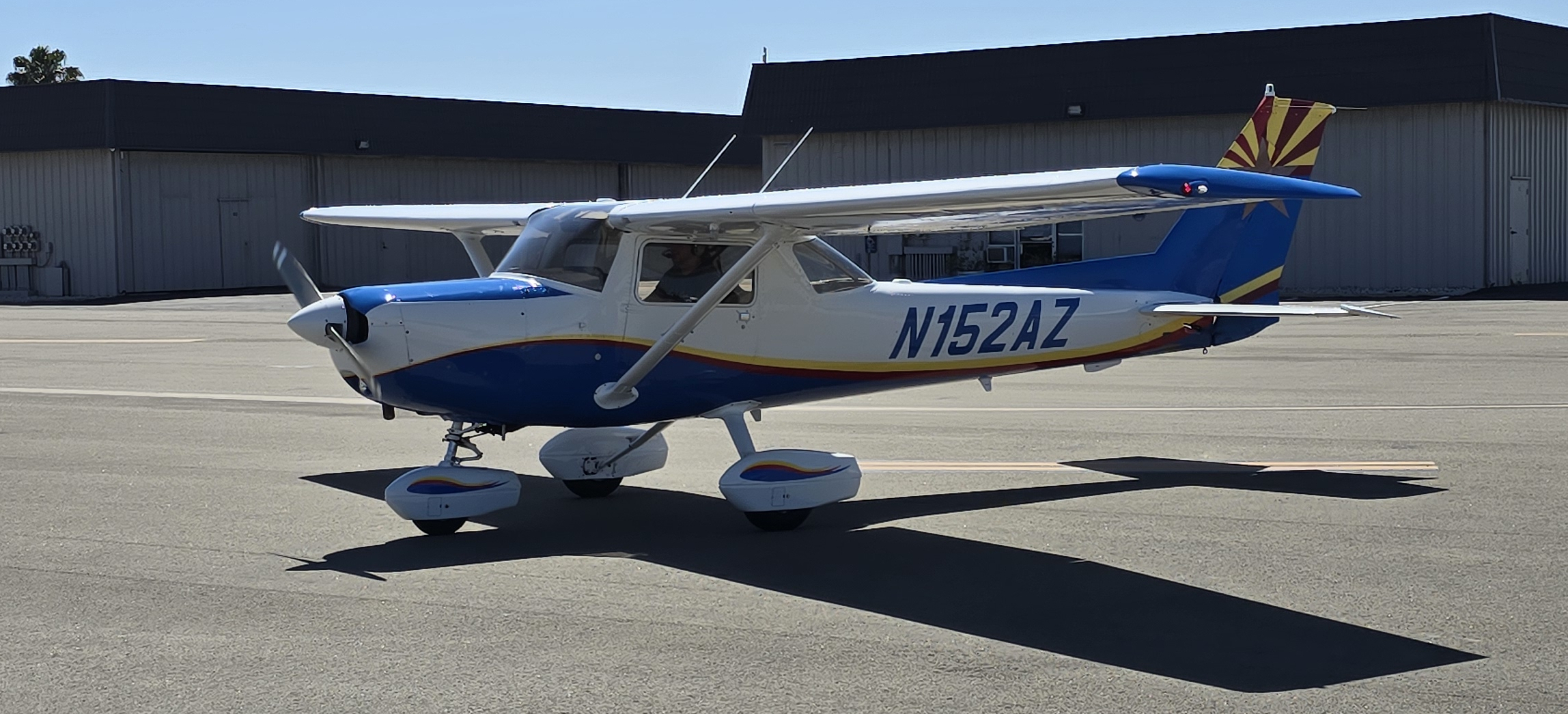
The first thing to consider is height and weight. The training is identical in both aircraft. Whether you are in a 152 or 172, the flight maneuvers and skills are the same. We will help you decide which aircraft is the right fit for your body, goals, and budget.
01.
Cessna 1522-seat trainer · primary aircraft
Recommended general limit 185 lb and under 6'1". Height is more a comfort issue than a hard limit. If you are close, come sit in one before you decide. We have nine 152s in the fleet, you will fit in at least one of them.
Weight
≤ 185 lb
Height
≤ 6'1"
Rate
$140 / hr
02.
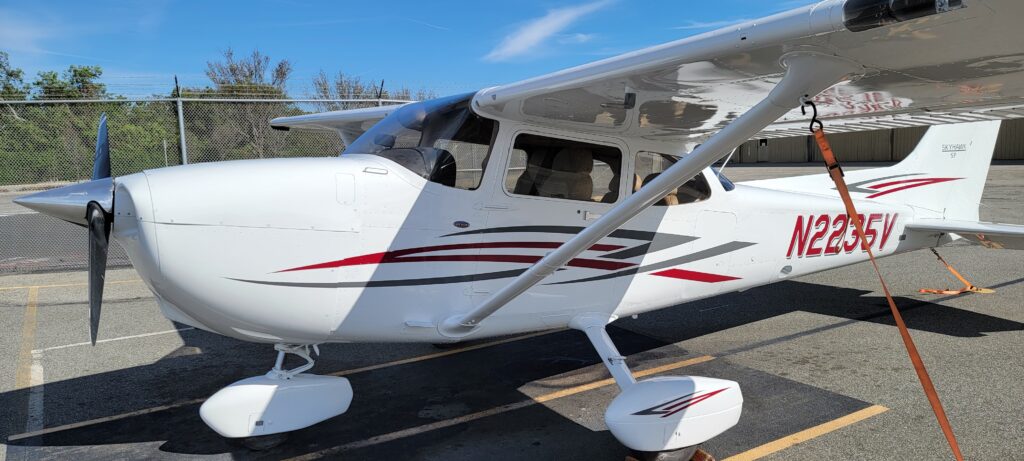
Cessna 1724-seat aircraft · for taller or heavier students
Better option for anyone who does not fit comfortably in the 152. Same training, slightly higher hourly rate, more room. Available in analog (N65537) or G1000 glass (N2235V) configurations.
Configuration
4 seats
Rate
$190 – $200 / hr
07 /
What Does It Cost?
Based on 70-hour US average
This is the most common question, and the hardest to answer with a fixed number. There are many variables: how often you fly, which aircraft you choose, how well you study, and your ability to retain and apply what you are taught. The breakdown below uses the US national average of 70 flight hours as a planning baseline.
Why our pricing looks different
We can do everything they can do. We just don’t price it like they do.
“A lot of people ask me why the bigger schools cost so much more, and my simple answer is greed. We don’t charge more because our primary goal isn’t to make the most money. It’s to provide high quality instruction and craft the best pilots we can. We also carry far less overhead. No middle management, no receptionist, and we have never spent a single dollar on advertising, the way they have to spend millions. We let our quality do the talking. Our training is about legacy, not profit.”
– Sam Raymond, Owner
Cessna 152 Path
Private
$22k
$22,485 – $22,705
Private Pilot License · 70 hrs.
Instrument
$16k
$16,140
Instrument Rating · 35 hrs + 20 sim.
Commercial
$14k
$14,625
Commercial Pilot License · 120 hrs.
Full Path
$53k
$53,250 – $53,470
Zero hours to Commercial Pilot.
Cessna 172 Path
Private
$25k
$25,985 – $26,905
Private Pilot License · 70 hrs.
Instrument
$17k
$17,365 – $17,715
Instrument Rating · 35 hrs + 20 sim.
Commercial
$18k
$18,125 – $18,825
Commercial Pilot License · 120 hrs.
Full Path
$61k
$61,475 – $63,445
Zero hours to Commercial Pilot.
Detailed Breakdown
Side-by-side line items at current aircraft, instructor, and simulator rates. Training quality and curriculum are identical in either aircraft.
Time Building · 100 hrs split with another pilot (varies by post-IR total)$7,000$9,500 – $10,000
Aircraft Training (20 hrs)$2,800$3,800 – $4,000
Instructor (37 hrs @ $90/hr)$3,330$3,330
Training Materials$60$60
Online Ground School~$60~$60
FAA Written Test~$175~$175
FAA Checkride~$1,200~$1,200
CPL Total$14,625$18,125 – $18,825
Full Path Total · Zero to Commercial$53,250 – $53,470$61,475 – $63,445
Personal Estimate
Already have hours from another school? Picking back up after a break? Tell us where you are and where you are going, and we will run the math for what is left.
Estimate only · read this
This calculator gives a planning baseline using national averages and our current posted rates. It is not a quote. Real-world cost depends on consistency, weather, retention, currency, your starting point, study habits, learning ability, and how the training actually unfolds for you. Come in for a free consultation and we will build a realistic budget around your specific situation.
Where you are
Where you are going
40557085100
70 hrs · US average
Very few students complete PPL in fewer than 70 hours. Plan for the average, not the minimum.
3545556575
55 hrs · typical average
The 35-hour FAA minimum is rarely hit. Most students need 50+ aircraft hours to reach proficiency.
Optional ratings beyond your Commercial certificate. Neither is required for any license, so they are not counted in the full path.
Real-world
Time since last flight
Current3 mo6 mo9 mo1 yr1.5 yr2 yr
Current / no break
Pay-as-you-go · Per lesson · No deposits
Your estimate at Aces High
$22,485–$22,705
~70 flight hours · 4–6 months at your chosen pace
Planned around the US average, not the FAA minimum. Final cost depends on consistency, weather, retention, currency, study habits, learning ability, and all the other variables that make every pilot different.
These numbers assume a decent level of self-study, good preparation, consistency, and drive on the part of the student. They are based on US averages and are in no way a guarantee of completion or passing of any checkrides. Final cost depends on the variables above.
The free consultation is the right first step. Bring your questions, your timeline, and any specific concerns. You will leave knowing whether this fits your life.